
Mortgage: how it works, what you need and which bank to choose
NaTwoim.pl » Blog » Mortgages »
A mortgage is a long-term loan to buy, build or renovate a property, secured by a charge (hipoteka) registered in the księga wieczysta (land register). You repay it in equal or decreasing instalments at a reference rate plus the bank's margin. To qualify, you need creditworthiness, a down payment (usually 20%, sometimes 10%) and a good BIK history.
What is a mortgage?
A mortgage (kredyt hipoteczny) is a bank loan to buy, build or renovate a property, secured by a mortgage charge (hipoteka) on that property. The bank is entered in the księga wieczysta (land and mortgage register, the public record of a property's owners and encumbrances) of the flat or house as the mortgage creditor. If you stop repaying the instalments, the bank can recover its money from the sale of the property.
This security is what sets a mortgage apart from a cash loan (kredyt gotówkowy). Thanks to it, the bank lends more, for longer and more cheaply. A mortgage is earmarked: the money goes to the purpose described in the agreement, not to any expenses you like.
In everyday Polish, "kredyt mieszkaniowy" (housing loan) and "kredyt hipoteczny" mean the same thing. Formally, a housing loan can also cover other property-related purposes, for example buying a building plot or finishing a flat.
How does a mortgage work, step by step?
The bank checks whether you can afford the instalment, values the property and issues a decision. After you sign the agreement, it pays the money to the seller and enters the mortgage in the księga wieczysta. Then you repay instalments for years according to a schedule.
- Checking your creditworthiness (zdolność kredytowa, the maximum amount a bank will lend you). Before you choose a flat, find out what amount you can count on.
- Umowa przedwstępna (preliminary sale agreement) or umowa deweloperska (agreement with a developer). You agree the price and the purchase date with the seller.
- Loan application. You submit income documents and property documents to one or several banks.
- Property valuation. A property valuer prepares the operat szacunkowy (valuation report), i.e. an estimate of the market value. The bank calculates the maximum loan amount from this value, not from the price in the listing.
- Loan decision and agreement. After a positive decision, you receive the agreement to sign. Read the clauses on early repayment and additional fees.
- Notarial deed and payout. After the akt notarialny (notarial deed, the purchase agreement signed before a notary) is signed, the bank transfers the money to the seller or the developer.
- Mortgage entry and repayment. The land register court (sąd wieczystoksięgowy) enters the mortgage, which takes from a few weeks to a few months. You repay the instalments according to the schedule.
In the past, banks added a higher, so-called bridging interest rate until the mortgage was entered. Today, as a rule, they do not, but check this in your agreement. Once the loan is fully repaid, you apply to have the mortgage removed from the księga wieczysta. You will find a detailed description of the formalities in the guide how to get a mortgage.
What changes with a house construction loan?
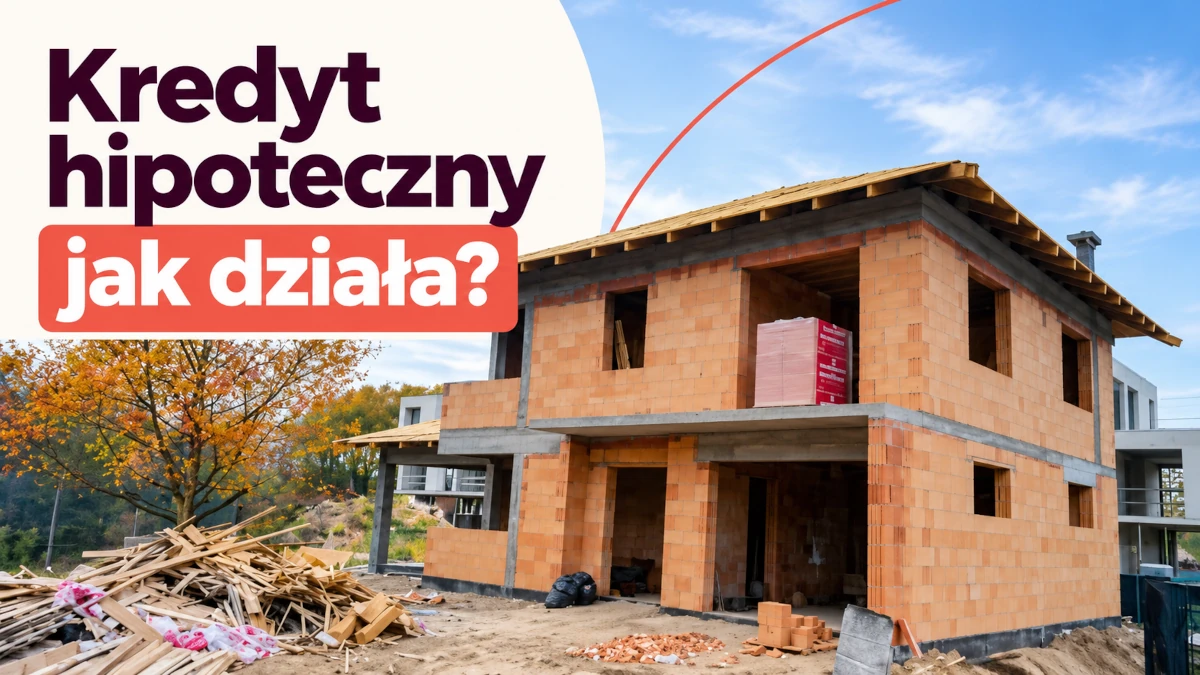
With a house construction loan, the bank pays out the money in tranches, according to the schedule of works. Before each tranche, it checks the progress of construction, for example through an inspection by a valuer. During construction you usually pay only interest on the amounts already paid out, and full instalments start after the last tranche is paid out.
What does a mortgage instalment consist of?
Each instalment has a capital part, which repays the amount borrowed, and an interest part, which is the bank's payment. Interest is calculated on the outstanding debt, so at the start it makes up most of the instalment, and its share falls over time.
The interest rate has two components: a reference rate, which reflects the cost of money on the market, and the bank's margin, which is fixed for the whole term of the agreement. With a variable rate, the instalment rises or falls together with the reference rate. With a periodically fixed rate, the instalment does not change for several years, usually five, and then the bank proposes new terms. You can read more about this choice in the article fixed or variable interest rate.
An illustrative example: a loan of PLN 400,000 over 30 years, interest at 6% a year for the whole term, equal instalments. The instalment is about PLN 2,398. In the first month, PLN 2,000 is interest and only about PLN 398 repays the capital. After 15 years, the interest falls to about PLN 1,421 and the capital part rises to about PLN 977. That is why overpaying in the first years gives the biggest savings.
Equal or decreasing instalments?
Equal instalments (raty równe) give a lower payment at the start, and decreasing instalments (raty malejące) a lower total cost. With decreasing instalments, the capital part is constant and the interest falls together with the debt.
| Loan of PLN 400,000, 25 years, 6% (example) | Equal instalments | Decreasing instalments |
|---|---|---|
| First instalment | approx. PLN 2,577 | approx. PLN 3,333 |
| Last instalment | approx. PLN 2,577 | approx. PLN 1,340 |
| Total interest | approx. PLN 373,162 | approx. PLN 301,000 |
| Effect on creditworthiness | higher available amount | lower, because the bank calculates creditworthiness from the highest, first instalment |
Decreasing instalments make sense if your income can carry higher payments at the start. The calculations leave out the commission and insurance. You can check your own scenarios in the mortgage calculator, which shows the full schedule split into capital and interest.
Mortgage: what do you need to get one?
You need creditworthiness, a down payment (wkład własny, the part of the price you pay from your own money), a clean history in BIK (Biuro Informacji Kredytowej, the Polish credit bureau) and a full set of documents: personal, income and property documents. The bank assesses you as a borrower, i.e. it checks whether you will repay the loan over the whole term of the agreement.
Age, income and credit history
Most banks require that on the date of the last instalment you are not over a certain age, usually 70–75. If you are 45 and want a loan for 30 years, some banks will offer a shorter term. Polish citizenship is not required, but a foreigner usually needs a stable income in Poland and an appropriate residence status.
It is easiest for people with an employment contract for an indefinite period (umowa o pracę na czas nieokreślony). With a civil-law contract (umowa zlecenia or umowa o dzieło), the bank may require a longer history of income, even 12 months. If you run a business (działalność gospodarcza), at least a year is usually needed, and some banks prefer two full years.
The bank will also check your history in the Biuro Informacji Kredytowej. Late payments on other loans lower your credibility, and having no history at all does not help either. Download your own BIK report a few months before you apply: clearing up an error reported by another institution can take several weeks. Your creditworthiness is also affected by other instalments and credit card limits, even unused ones.
How much down payment do you need?
The standard is 20% of the property's value. Some banks will accept 10% if you pay for low down payment insurance or use a state-guaranteed programme such as Rodzinny Kredyt Mieszkaniowy (Family Housing Loan). Programme conditions change, so check them before you apply.
Example: for a flat costing PLN 450,000 with a 20% down payment (PLN 90,000), you borrow PLN 360,000. With a 30% down payment (PLN 135,000), the loan drops to PLN 315,000. Over 30 years at 6%, the instalment falls from about PLN 2,158 to about PLN 1,889, and total interest from about PLN 417,000 to about PLN 365,000. This is an indicative calculation.
The down payment does not have to be cash. The bank may accept the plot on which you are building a house, or a deposit paid earlier to the developer. If part of the money comes from a gift, prepare a document confirming its source.
What documents should you prepare?
Documents fall into three groups: identity and family situation, income, and the property. The range of income documents depends on your form of employment.
| Source of income | Typical income documents |
|---|---|
| Employment contract (umowa o pracę) | certificate from your employer confirming your employment and earnings, bank statement for recent months |
| Umowa zlecenia or umowa o dzieło | contracts and bills, statements showing regular income, often for 12 months |
| Business (działalność gospodarcza) | tax returns, księga przychodów i rozchodów (revenue and expense ledger) or balance sheet, documents for at least one year of business |
On top of this come the property documents: an extract from the księga wieczysta, the preliminary or developer agreement and the operat szacunkowy. For a house construction, the bank will also ask for the building permit, the design, the cost estimate and the schedule of works. Get the extract from the księga wieczysta just before you apply, because the bank may require an up-to-date one. The bank will also ask about the number of your dependants and your fixed expenses. We describe who has the best chance of a positive decision in the article who will get a mortgage.
What insurance does the bank require?
The bank almost always requires property insurance against fire and other random events. Life insurance is sometimes mandatory, especially with a single borrower, or it is a condition for a lower margin. Ask whether a given policy is required or only lowers the price of the loan, and include its cost in your budget.
Which bank makes it easiest to get a mortgage?
There is no single bank where it is easiest to get a mortgage. You will get one most easily at the bank whose lending policy fits your source of income, down payment and credit history. The same application can be refused at one bank and approved at another.
Each bank has its own rules for assessing risk and calculating creditworthiness. One is more willing to finance sole traders, another prefers people in employment. Banks change these rules even several times a year, which is why a ranking of the "easiest banks" quickly goes out of date.
Your chances depend above all on:
- creditworthiness – the level and stability of your income, the number of dependants, other instalments and limits;
- BIK history – whether you have repaid your existing commitments on time;
- down payment – the higher it is, the lower the risk for the bank;
- form and length of employment – with civil-law contracts and a business, the bank wants a longer income history;
- the property – its legal status in the księga wieczysta and the valuer's valuation.
Instead of looking for an "easy" bank, apply to two or three at the same time and compare the actual decisions, not advertising slogans. Credit enquiries are recorded in BIK, so submit your applications within a short time of each other. Before you apply, pay off small commitments and do not take on new ones, because every additional instalment lowers your creditworthiness.
Comparing several banks is easier with a credit expert who follows their rules on an ongoing basis and knows which bank currently takes a more lenient view of, for example, a short employment history or a young business. You pay nothing for this; NaTwoim receives a commission from the bank on the disbursed loan. We explain the details in the article how much it costs to work with a mortgage broker.
Which mortgage is the cheapest?
The cheapest loan is the one with the lowest total cost for your amount, term and down payment, not the one with the lowest instalment or the margin from an advert. The best measure is the RRSO (rzeczywista roczna stopa oprocentowania, the annual percentage rate including all loan costs, known in English as APRC).
The RRSO includes interest and the costs you must pay to get the loan: commission, required insurance and fees, for example for running an account. The bank must state the RRSO and the total cost of the loan before you sign the agreement. Online mortgage rankings are only a starting point, because they assume sample parameters that rarely match yours.
When comparing offers, check:
- the RRSO and the total amount to repay for the same amount, term and type of instalments;
- the margin and type of interest rate – fixed for several years or variable;
- the commission – a one-off fee for granting the loan;
- additional conditions – an account receiving your salary, a card, a policy; check how much the margin will rise if you give them up;
- the cost of the property valuation and of insurance in later years;
- early repayment rules – whether and how much the bank charges for an overpayment.
A higher down payment often lowers the margin, and a shorter loan term lowers the total interest. Some banks negotiate terms, especially for a higher amount or good creditworthiness.
What is the minimum mortgage term?
The law does not set a minimum mortgage term; the bank sets it. With a variable rate, many banks set no minimum or require about 12 months. With a periodically fixed rate, the loan term usually has to cover at least the fixed-rate period, most often 5 years.
A short term means a high instalment, and therefore high required creditworthiness. For a loan of PLN 300,000 at 6%, the instalment over 12 months would be about PLN 25,820. That is why people usually take a one-year mortgage when they know where the money for quick repayment will come from.
| Loan of PLN 400,000, 6%, equal instalments (example) | Instalment | Total interest |
|---|---|---|
| 15 years | approx. PLN 3,375 | approx. PLN 207,577 |
| 20 years | approx. PLN 2,866 | approx. PLN 287,774 |
| 25 years | approx. PLN 2,577 | approx. PLN 373,162 |
| 30 years | approx. PLN 2,398 | approx. PLN 463,353 |
A shorter term means less interest, but a smaller buffer for unexpected expenses, job loss or rising rates. Many people choose a longer term and overpay the loan when they have spare money. If that is your plan, check the early repayment rules in the agreement.
A one-year mortgage: an example from practice
A client from Warsaw was buying a flat from a developer, and she was due to receive the money from selling another property in about eight months. With a short loan term, the instalment would have exceeded her creditworthiness. So we chose the bank with the shortest possible term that still gave a positive decision, with no commission for granting the loan and no early repayment fee.
The cost of the loan in the bank's offer is calculated assuming repayment over the whole term of the agreement. If you repay early, you pay interest only for the time you actually used the money. With such a short horizon, the margin was of secondary importance; what mattered were zero set-up costs and no compensation for early repayment.
Frequently asked questions
What can you spend a mortgage on?
On the housing purpose described in the agreement: buying a flat or house on the primary or secondary market, construction, renovation, buying a building plot or repaying another housing loan. For any purpose, there is the pożyczka hipoteczna (mortgage-secured loan for any purpose), which is also secured by a mortgage but is usually more expensive.
How long do you wait for a loan decision?
From a few days to a few weeks, depending on the bank and on whether your documents are complete. The Mortgage Credit Act (ustawa o kredycie hipotecznym) gives the bank 21 days to make a decision, counted from when you provide all the information needed to assess your creditworthiness. On top of that comes the time to sign the agreement, the akt notarialny and the payout.
Can you repay a mortgage early?
Yes, in full or in part, at any time. With a variable rate, the bank can charge compensation only during the first 3 years of the agreement; with a periodically fixed rate, the rules are set by the agreement. You pay interest only for the period in which you used the money.
What is the instalment on a PLN 400,000 loan over 25 years?
It depends on the interest rate and the type of instalments. At 6% a year with equal instalments, the instalment is about PLN 2,577, and at 7% about PLN 2,827. These calculations are illustrative and leave out the commission and insurance.
What is the maximum loan term?
Most often 30 or 35 years. Rekomendacja S (Recommendation S) of the Komisja Nadzoru Finansowego (KNF, the Polish Financial Supervision Authority) advises banks to offer terms of up to 25 years and does not allow loans longer than 35 years. The actual limit also depends on your age on the date of the last instalment.
Talk to a credit expert
If you want to check your creditworthiness and compare offers from several banks for your situation, book a consultation with a NaTwoim credit expert in Warsaw. The consultation is free for you. Contact us.
